Neighborhood Residents: The Coyote
By: Quinn Rider, BS Ecology, Behavior, & Evolution, BVAC Retail Manager
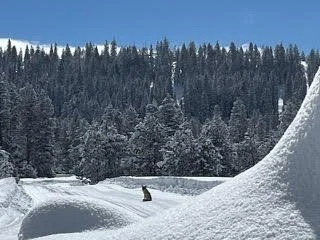
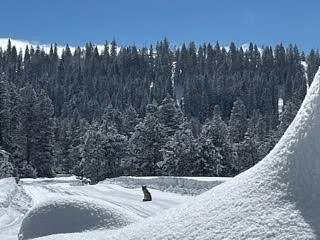
There is at least one Bear Valley resident enjoying our low snow year. They will be familiar to many of you. Traveling on four paws and generally considered a pest, coyotes are natives of the Sierra Nevada and fulfill necessary ecosystem roles, like controlling prey populations. Coyotes are generalist mesocarnivores, practicing both hunting and scavenging for meat and plant materials. Large carnivores as a whole are among the most threatened categories of mammals facing threats including, but not limited to, habitat destruction, persecution by humans (most often over livestock related conflicts), decreased prey populations, and hunting and trapping. Most large carnivores have seen their ranges contract significantly in our increasingly developed world. American Black Bears, for example, have lost 38.6% of their historical range; some species like the red wolf have seen range contractions of 99%. Coyotes, however, have seen range expansions of 40% in the last 120 years. This expansion has likely been driven by a number of factors, including hybridization with wolves in the eastern US and the decreased presence (and in many cases, extirpation) of other competing large carnivores within the same area. Coyotes are now the largest carnivore present throughout much of the Eastern United States. The Sierra Nevada, however, has long been a part of the coyote’s range, with fossil finds dating coyote presence in the region as far back as 780 thousand years. Another contributing factor to their success is their generalist diet, which varies by season and location. Coyotes rely on many prey species within the Sierra. A study of coyote scat found their main prey species were pocket gophers (27% of the prey they consumed), deer (17%), white tailed jack rabbits (12%) and marmots (11%). They prey on voles, deer mice, birds, and other rodents as well, though to a lesser extent. In snowy winter areas, coyotes up their consumption of deer as marmots and pocket gophers hibernate out of their reach. In low snow winters like this one, they will also consume a significant quantity of snowshoe hare, a prey they often find outmaneuvers them in the deeper snow of heavy winters. Also found in the studied scat were traces of pine, presumed to be from pine nuts. Coyotes have been known to raid squirrel middens to steal their pine nut cache. Any Bear Valley-ite will also know that coyotes quite like our trash. They will snatch bags from dumpsters left open or steal trash from bears once the heavy lifting of opening the canisters has been done. However, most Sierra coyote studies I could find stated that anthropogenic sources of food were relatively rare in their samples. Coyotes travel over vast swaths of land in their pursuit of food, occupying home ranges that vary between 2,470 and 24,700 acres. While navigating across the landscape, coyotes most often travel between foraging areas in straight lines, meandering only once they hit foraging grounds. After a fresh snowfall, I like to take note of the coyote prints along the side of the snow-road in Sky High. They do indeed usually travel in straight lines, though all bets are off once they hit the parking lot, an area they clearly consider a foraging ground. What I usually do not see are the coyotes themselves, who shift their crepuscular behavior (most active at dawn and dusk) towards nocturnal activity in zones of human usage like neighborhoods and ski resorts. I’m sure many have also noticed they typically stick to paths of compacted snow. Coyotes have a relatively large body size in comparison with their feet, a trait not well adapted to snow travel. Not fans of post-holing, they often utilize snow-roads, ski and snowshoe trails, and snowmobile tracks to further their access to terrain. This increased access is into winter territories previously utilized by the Sierra Nevada Red Fox, and may pose dangers to their conservation. As humans have expanded into more natural areas and coyotes have expanded into urban ones, we have seen an increase in human-coyote conflict. There are a number of things to keep in mind when encountering coyotes. The first is that they are our neighbors in this landscape. While coyote attacks are rare, they can happen. To reduce the chance of aggressive encounters, do not feed or leave food where they can easily access it. Do not leave small pets unsupervised outside. If you are outside and a coyote approaches you, be sure to keep small children and pets close to you. Wave your arms and make loud noises (hazing). In order for hazing to be effective, you must continue until the coyote has entirely left the area. That said, keep an eye out for one of the resident coyote pairs that occupy the meadow during the day once the skiing season ends! They are a breeding pair (coyote breeding season usually lasts from February to May) and will dig holes in the snow along the stream as they hunt for a pounce on mice. Happy observing and stay safe!