6 Marmot weeks of Winter
By: Quinn Rider, BS Ecology, Behavior, & Evolution, former BVAC Retail Manager
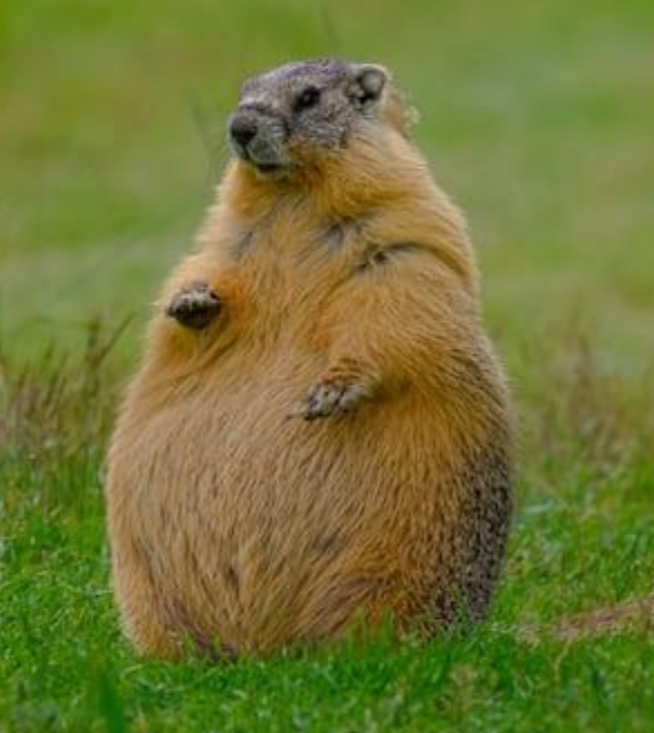
As a late season snow storm works its way across the Sierra (Awesome April?), I'm reminded of the small, furry weatherman who predicted this may happen - he goes by the name of Punxsutawney Phil. Groundhogs, also called woodchucks, are a species of marmots, Marmota monax to be precise. While we don’t have groundhogs in Bear Valley, their close relations, the Yellow Bellied Marmot (Marmota flaviventris), are one of my favorite neighborhood residents!
How do marmots know when to emerge from hibernation? Well, if you go by Punxsutawney Phil’s stats, they kind of don’t. Phil is only accurate about 40% of the time, so what exactly is he basing his prediction on? During hibernation, marmots enter torpor, a low metabolic state in which their body temperature drops to just above ambient temperatures. During this foodless state, they lose only about a gram every day. However, for creatures that only weigh about 3-4 kg on average and spend seven to eight months hibernating, that weight loss quickly adds up. If marmots hibernate too long, they may starve to death in their burrows, but if they emerge before the snow melts and can’t find food, they may starve above ground. Survival hinges on finding the sweet spot between emerging too early and too late. The mechanisms that govern emergence aren’t entirely understood. Studies point to some type of circannual rhythm, an internal clock, that keeps them on schedule. The emergence of male marmots tends to come earlier than that of females and correlates with the date when about 50% of the snow cover has melted. Males emerge early to carve out their territories and or establish dominance hierarchies, an important task because as soon as hibernation ends, mating season begins!
Marmots have complex and variable social structures. The majority of marmots (about 75%) live in colonies composed of one or multiple males and multiple females. Marmot colonies are composed of both recruits and familial lines. When they emerge from their first hibernation, all yearling males and about half of yearling females will leave or be driven out of their colony. Marmot colonies are, from a female perspective, matrilineal, with tolerant mothers recruiting their daughters to stay within the colony. There may be 3 to 13 females of the same line within a colony at the given time. Some mothers, however, are not so tolerant and may drive off any young who choose to stay. Colonies may also contain multiple males, but they are rarely related. While they are growing in prevalence, multi-male groups still make up less than half of colonies. The mechanisms driving this shift and the resulting breeding dynamics are still not entirely understood, though it seems the most dominant male (determined by size) may or may not allow the other males to mate depending on the colony.
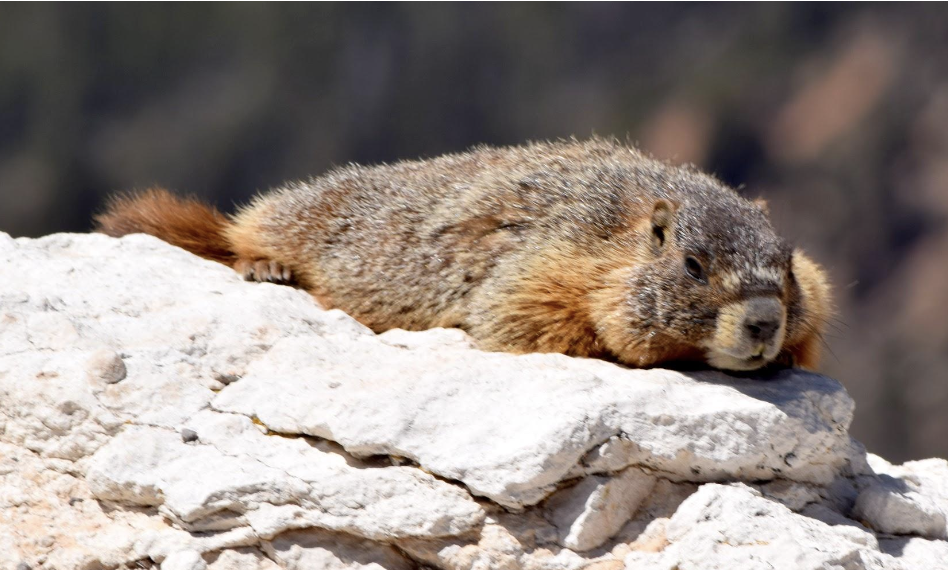
Marmot colonies provide safety in numbers, actively patrolling their territory. Colony sites are selected based on rock and log presence and slope, rather than food availability. These factors provide them with perches and clear views over the surrounding landscape so that they can scan for their natural predators: coyotes, black bears, badgers, martens, and eagles. They use sight, sounds, and smells to sense predators and emit alarm-calls to warn their colony of threats. These alarm calls are responsible for another common name of marmots - “whistle-pigs.” Whistle-pigs have individual identifiable alarm calls and tailor their response to alarms based on which individual made it. They respond strongly to alarm calls from juveniles, who are the most predated upon, and calls that are particularly noisy or chaotic. Most other alarm calls are met with a period of their own inspection. Inspection length varies based on who made the call and whether or not they are reliable, reliability possibly being determined by familial relation. When alarm calls are deemed credible, they will retreat into their burrow to hide. They will return outside at the earliest safe opportunity, resuming foraging, their constant quest in the summer. They must at least double their bodyweight over the summer to survive the long winter ahead. Foraging will be broken only by periods of rest, patrolling, and of course, lounging on rocks in the summer sun, an essential activity engaged in by every marmot, though researchers don’t understand why.
With this snow storm rolling through, it looks like summer sunning will have to wait. Head back in your burrows folks, looks like we’re in for six more weeks of winter.
Works Cited
“Behavioural Adaptations.” Central Eastern Alps, https://centraleasternalps.weebly.com/behavioural-adaptations.html.
Blumstein, Daniel T et al. “Ontogenetic variation of heritability and maternal effects in yellow-bellied marmot alarm calls.” Proceedings. Biological sciences vol. 280,1758 20130176. 6 Mar. 2013, doi:10.1098/rspb.2013.0176
Blumstein, Daniel T et al. “Reliability and the adaptive utility of discrimination among alarm callers.” Proceedings. Biological sciences vol. 271,1550 (2004): 1851-7. doi:10.1098/rspb.2004.2808
Blumstein, Daniel T et al. “Social Effects on Emergence from Hibernation in Yellow-Bellied Marmots.” Journal of Mammalogy, Volume 90, Issue 5, 15 October 2009, Pages 1184–1187
“Marmota flaviventris.” Animal Diversity Web, University of Michigan Museum of Zoology, https://animaldiversity.org/accounts/Marmota_flaviventris/.
Johnson, V., and J. Harris. “Life History Account for Yellow-Bellied Marmot (Marmota flaviventris).” California Wildlife Habitat Relationships System, California Department of Fish and Wildlife, California Interagency Wildlife Task Group, Jan. 2008, https://nrm.dfg.ca.gov/FileHandler.ashx?DocumentID=2405.
“A Marmot’s Life.” Rocky Mountain Biological Laboratory Marmot Project, University of California, Los Angeles, https://sites.lifesci.ucla.edu/eeb-rmbl-marmots/a-marmots-life/.
Svendsen, Gerald E. “Structure and Location of Burrows of Yellow-Bellied Marmot.” The Southwestern Naturalist, vol. 20, no. 4, 1976, pp. 487–94. JSTOR, https://doi.org/10.2307/3669865.
“Yellow-Bellied Marmot (Marmota flaviventris).” National Park Service, U.S. Department of the Interior, 9 Jan. 2024, https://www.nps.gov/jeca/learn/nature/yellow-bellied-marmot-marmota-flaviventris.htm.